
*Elliott Yang Bingshi drew the cover
How is China's Economic Slowdown Affecting Youth Unemployment and What Can Be Done?
By Eric JIANG Junzhe

Jackson Li, 22, a graduate of the University of Hong Kong, spent more than six hours a day scrolling down the job seeking apps on his phone and looking for opportunities in both Hong Kong and mainland China.
“I’ve been searching for a job for about half a year, and it’s extremely hard for a humanities-related subject student like me,” Li said. “In mainland China, people rush to the IT giants, and those companies want more science-related students,” Li explained. “Meanwhile, Cantonese is a barrier for me to get a job in Hong Kong, especially for the shrinking media industry.”
Li felt stressed when his parents asked about his employment situation, and many of his friends who majored in high-tech fields found jobs such as computer science, new energy, and semiconductors. He had to live on his parents and was burdened by the high rental prices in Shenzhen.
Li’s experience could be tracked by the greater issue in China, which is long-term unemployment, a major “grey rhino”, dragged by the legacy of COVID-19 and the worsening Sino-US relations.
Meanwhile, many investors and analysts regard the silver economy and high-tech industries as solutions to the labour headwinds under the ageing society and low birth rate in China.The unemployment rate of the youth group from 16-24, excluding students, decreased by 0.7 percentage points to 15.8% in April from a month earlier. The urban unemployment rate, on average, stood at 5.1% in 2024, higher than the 3% baseline, according to the National Bureau of Statistics.
Fu Linghui, the spokesman of the NBS, said the employment situation was “generally stable” in 2024 because of the economic expansion, increasing job positions in the service sectors, and the government’s “employment first” policy.
The Chinese government set another GDP goal of around 5% annual growth in 2025 in the two sessions, the annual meeting of the Chinese legislature. The Hang Seng Bank projected the Chinese GDP would be 4.9% growth from 2024 due to the stimulative fiscal and monetary policies and improving outlook for domestic sectors, according to their 2025 first quarter report.
Although the Chinese economy keeps expanding, unemployment is still worth noticing after the COVID-19 pandemic. Thomas Yuen Wai-kee, an assistant economics professor from Hong Kong Shue Yan University, saw the economic downturn caused by the pandemic as a major reason contributing to unemployment.

“The Chinese economy was dragged by the pandemic during the past two or three years, and we don’t have enough capacity to absorb more graduates,” said Yuen.
Yuen thinks it’s a bad time to graduate because China has too many university students at the moment.
The annual Chinese GDP growth rate reached 5% last year after a huge decline to 2.2% when the pandemic started in 2020, but it still cannot recover to the pre-pandemic level, according to the NBS.
Trading Economics claimed the data from the NBS that the youth jobless rate started increasing in 2021 and peaked at 21.3% in June 2023, respectively. However, NBS suspended the release of youth unemployment in August of the peaking year, citing that the labour force survey statistics “need further enhancement and optimisation.”
Gary Ng, the senior economist at Natixis, said the pandemic weakened economic growth and business confidence, which made the unemployment issue more noticeable compared with a decade ago.
“It’s more difficult for students to find a job than 10 years ago as their households have accumulated wealth for them to find what they want to do,” Ng said. “The pandemic hurt the economy and companies’ investment confidence in a certain way, which pushed the students to delay their time to enter the job market and pursue further studies.”
Juno Sun, 22, was one of those students who wanted to enter the job market later in Dalian and had just finished the Postgraduate Entrance Examination in December.
The vast number of candidates in the exam forced her to study harder during the 10-month preparation.“I would say it’s really hard to pass the Postgraduate Entrance Exam, and I was shocked that about 70% of my classmates were preparing for the exam,” Sun said.
“I started my preparation last February and spent more than eight hours reviewing the exam,” she explained. “When it comes to the last month, I had to get up earlier and study about 13 hours per day.”

Sun gets up at 6:30 am to prepare for the exam and has no time to take a snap. (Photo Courtesy: Juno Sun)
There were 3.88 million students who chose to take the Postgraduate Entrance Examination this year, which decreased by more than 10% from a year earlier as the exam is getting more complicated, marking the third time decline in history, according to Education Online.

Sun wants to pursue her master's degree at the Dalian University of Technology, which is her Alma Mater as an undergraduate. (Photo Courtesy: Juno Sun)
However, the number of students who want to pursue further study in China increased by 1.6 percentage points compared to last year, especially for students from first-class universities, according to a survey conducted by Zhaopin.com, a Chinese job-seeking platform.
Despite the process being challenging, Sun believed that it would be worth pursuing a master’s degree in China to help with the job seeking.
“A master’s degree is a threshold for a student to get a job at the current stage, Sun said. “Meanwhile, I feel that I am afraid of starting my career as an adult, and I hope to find out what I want to do during my time in school.
The result of the Postgraduate Entrance Examination was released on Feb. 24.
Juno Sun ranked 112nd among the candidates for her dream school.“I may not be admitted this time, but I believe there will be something good to happen afterwards,” said Sun.
How do Sino-US relations shape the labour market?
Besides the pandemic, the trade war between China and the US and the Chinese family’s values also add to the jobless issue, according to Wei Liqun, a professor of management at Hong Kong Baptist University.
The data reflected that the US was still the biggest destination for Chinese foreign orders, which accounted for 14.7% of the total exports, with US$ 476.7 billion (around HK$ 3798.1 billion) in the first 11 months of 2024, according to Chinese Customs.
However, US President Donald Trump raised another round of trade wars between the two biggest economies by signing an executive order to add 10% more tariffs on imported goods from China on Mar. 3, according to the White House.
The Chinese government imposed tariffs of up to 15% on farm goods from the US and blocklisted 20 American companies in retaliation for the sanctions on the same day, according to the state-owned news agency Xinhua.
With rounds of repeated add-ons, Trump’s administration finalised as high as 245% tariffs on goods from China and paused different margins of reciprocal tariffs on major trade partners for 90 days, which suppress domestic wages and consumption, to “make America wealthy again" from Apr. 14, the White House said. Meanwhile, the de minimis exemption for small-value goods will no longer be applied to Chinese retailers from May. 2.
“Countries and firms reliant on exporting to the US will face a big shock”, said Gary Ng, the senior economist at Natixis, in a social media post.
“If the US keeps the tariff scale, eventually, it can drag the world into recession. There can still be room for bilateral negotiation and bring the tariffs lower, but the world should expect the US to keep a certain tariff level.”
In retaliation, the Chinese government said on April 11 that it imposed 125% retaliatory tariffs on goods imported from the US.
“This practice of the US is not in line with international trade rules, seriously undermines China’s legitimate rights and interests, and is a typical unilateral bullying practice,” China’s State Council Tariff Commission said in a statement.
Ng the economist, believed Beijing’s tit-for-tat tariffs aimed to increase the bargaining chips for negotiation, but the structural disagreement would make it more challenging to reach a deal with the US than with other countries. “One more point to note is that the pressure on the revenue in China includes manufacturing in third countries, but production for the US,” he said.

Professor Wei said: “The trade war between the two superpowers decreased the Chinese export orders so that many companies are laying off their employees and reducing their positions.”
In addition, the traditional Chinese families’ thoughts put too many expectations on the university students to be elites or white collars instead of blue-collar factory workers, she added.
The PMI of the world's second-largest economy showcased the contraction in the manufacturing sector after the three-month expansion last year, with the figure dropping to 49 in April which was under the 50 baseline, according to the NBS.

“The whole economy suffered greatly when COVID-19 and the trade war came together.”
Wei believes manufacturing is still China's advantage and could provide many employment positions.
“Chinese parents are keen on high-end jobs; even students from the second and third-tier universities are not willing to be technical workers, which is a very horrible thing,” said Wei.
“This kind of situation will generate a mismatch between the industry and labourers and lead to structural unemployment and labour divide as the government promotes industrial upgrading in manufacturing.”
Wei’s opinion echoed a survey from Zhaopin.com in 2024 that more than half (56.6%) of fresh graduates from technical colleges can find jobs, with 45.4% and 44.4% of those with bachelor’s and master’s degrees eventually finding jobs, respectively.
Conversely, when the Chinese economy moves towards high-tech industries, advanced talents like AI engineers can find a job easily, making it harder for ordinary people, according to Thoms Yuen.
In the same vein, Gary Ng of Natixis said the advanced industries, including AI and semiconductors, will first reduce some positions and cause unemployment.
The number of job postings related to the AI industry is decreasing.
However, Zheng Danna, the general manager of a tech industry headhunting firm, Dolphin Leap Recruitment, said there is a talent shortage in the technology industry, whether it’s soft technologies such as AI, cloud edge computing, and data governance or hard technologies, including robots, chips, and new energy.
“Interdisciplinary skills and talents in expanding business overseas are important for candidates to get into the tech companies,” Zheng said. “At the same time, the ambidextrous technical workers and relationship marketing talents are also popular with the companies.”
There are jobs, but those are a mismatch: job seekers
Many job seekers are rushing to career fairs held by the local government.


More than 800 positions are provided at the career fair held by the Shenzhen government on Mar .4.
The government service centre of Futian district is located in the NextPark, the central business district of Shenzhen. They hold online and offline career fairs for citizens in Shenzhen almost every week in March.
Job seekers can easily register for career fairs through the government’s mini-app on WeChat.
The opening positions are in different industries, such as housekeeping, banking, and beverage. Some of them are especially for mothers, as the working hours are more flexible for them to pick up their kids.

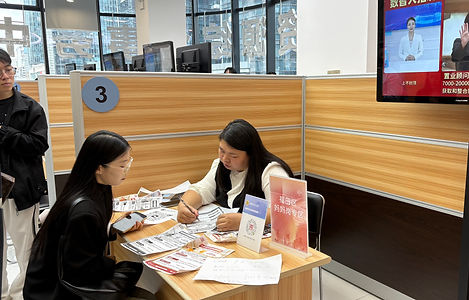
At 10 am on Mar. 4, the career fair was crowded with people. Jessica Zhang, 32, who lost her job last year, was one of them, and this is her first time joining the government’s career fair.
Leyoujia, a real estate agency based in Shenzhen, is hiring “mothers” for property sales.
It’s really hard for her to find a job compared to a few years ago when she had just graduated from junior college in Shenzhen, according to Zhang.
“I want to find a business assistant job at this career fair,” said Zhang. “Although there are many positions here, I still can’t find a suitable one, as many of them are sales positions.”
Meanwhile, it seems that companies are also having difficulties hiring people for certain positions because of the mismatch.
Wu Yuting, the associate sales manager of China Citic Bank Credit Card Centre, said only 10 people were asking for the job openings.
“We planned to hire around 15 people in total for every department,” said Wu. “It’s still challenging for us to hire young people as they are not interested in sales positions and feel the dead-end of the credit card industry.”